
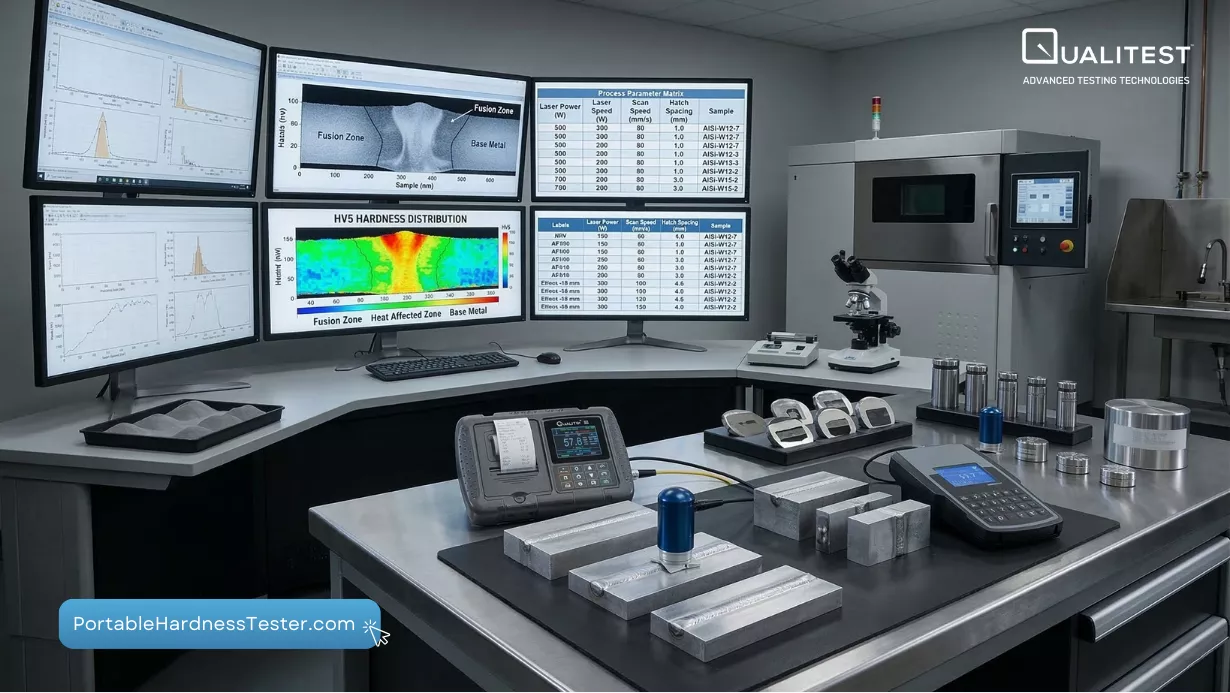
For additive manufacturing (AM) engineers, AlSi10Mg is a staple due to its excellent castability and high strength-to-weight ratio when processed via Laser Powder Bed Fusion (PBF-LB). However, as AM shifts from prototyping to the production of larger, multi-part assemblies, the need to weld these components arises.
Tungsten Inert Gas (TIG) welding is often the first choice for joining PBF-LB parts, but it introduces a thermal shock that can dramatically alter the carefully engineered microstructure of the base material. A recent study published in MDPI Metals (2025) highlights that hardness in these joints is not just a single value, but a complex map dictated by build parameters, heat treatment, and—most critically—hydrogen-driven porosity.
Why Joining PBF-LB AlSi10Mg is Challenging
Welding PBF-LB aluminum is fundamentally different from welding wrought or cast counterparts. Two primary factors complicate the process:
- Hydrogen Sensitivity: The high surface area of aluminum powder, combined with potential moisture uptake during handling and storage, makes PBF-LB parts “hydrogen reservoirs.” During the remelting phase of TIG welding, this hydrogen is released, leading to significant porosity in the weld metal (WM).
- Microstructural Disruption: PBF-LB produces an ultrafine, cellular-dendritic microstructure with high as-built strength. The high heat input of TIG welding destroys this refinement in the Heat-Affected Zone (HAZ) and Weld Metal, creating a “softening” effect.
Study Design: The Variables at Play
To understand how to mitigate these issues, researchers evaluated several key variables:
- Layer Height: 30 µm vs. 60 µm (Affecting the initial thermal history and precipitation state).
- Plate Thickness: 3 mm vs. 5 mm.
- TIG Parameters: Grouped by line energy regimes tailored to thickness.
- Filler Material: Comparing AlSi-based filler wire against autogenous (no filler) welds.
- Post-Weld Heat Treatment (PWHT): Standard T6 cycle (solution treatment + quench + artificial aging).
Results: The Hardness Map (BM → HAZ → WM)
Hardness measurements (HV0.5) taken with a portable hardness tester for metals provide a “fingerprint” of the joint’s mechanical health. The study reveals a stark contrast between the as-welded and T6-treated states.
1. The As-Welded Condition (Maximum Mismatch)
In the as-built state, the Base Material (BM) retains the high hardness granted by the rapid solidification of the PBF-LB process.
- BM Hardness: ~125–130 HV
- WM Hardness: ~70–80 HV
- HAZ Hardness: ~70–90 HV The Verdict: There is a significant “hardness drop” in the weld region, making the joint a mechanical bottleneck.
2. Post-Weld T6 Condition (The Equalizer)
Applying a T6 heat treatment after welding fundamentally shifts the profile. Interestingly, while T6 is usually intended to strengthen, its effect on PBF-LB BM is a reduction in hardness due to the coarsening of the silicon network.
- BM Hardness: Decreases to ~60–75 HV
- WM Hardness: Rises slightly/stabilizes at ~70–80 HV
- HAZ Hardness: Can drop as low as ~55–65 HV in specific combinations. The Verdict: T6 reduces the hardness mismatch between the BM and the weld, creating a more homogenous—though overall softer—component.
| Factor | Expected Hardness Impact | Practical Note |
| Lower Layer Height (30 µm) | Increase in BM hardness | Finer initial microstructure leads to higher as-built strength. |
| Post-Weld T6 | Decrease in BM; Stabilization of WM | Good for reducing stress concentrations, but lowers overall part hardness. |
| High Line Energy (TIG) | Wider HAZ | Increases the volume of the “softened” zone around the weld. |
| Porosity (~11–19%) | High Scatter in WM readings | Hardness values in the WM may be deceptive if the indenter hits a sub-surface pore. |
The Mechanistic Shift: Why Hardness Changes
The fluctuations in hardness are tied directly to the morphology of Silicon and Mg₂Si precipitates.
In the as-built PBF-LB condition, silicon forms a continuous, fine cellular network that provides high hardness through grain boundary reinforcement. TIG welding melts this network. When T6 heat treatment is applied, the silicon particles spheroidize and the Mg₂Si precipitates change distribution. In the BM, this results in a loss of the original AM reinforcement, while in the WM, it provides a slight boost in strength compared to the as-cast-like state of the raw weld.
The Porosity Constraint
A critical finding of the 2025 study is that porosity remains stubbornly high (11–19%) regardless of the heat treatment or layer height. This porosity is the “ceiling” for joint reliability. Even if T6 improves the hardness profile, the actual tensile strength of the joint is often dictated by the effective cross-sectional area (reduced by pores) and the stress concentrations those pores create.
Practical Guidance for Engineers
If you are tasked with validating or optimizing PBF-LB AlSi10Mg joints, consider the following hierarchy of priorities:
- Hydrogen Control is Priority #1: Before worrying about T6 cycles, optimize powder storage and shielding gas quality. High hardness is useless if the weld metal is essentially a “metallic sponge.”
- Trade-offs of T6: Use T6 if your application requires a uniform mechanical response across the part. Avoid T6 if the high as-built hardness of the PBF-LB component is the primary design requirement.
- QC Workflow: * Step 1: Perform macro-porosity checks via cross-sectioning.
- Step 2: Generate a hardness map (HV0.5) to identify the width of the HAZ.
- Step 3: Use microscopy to correlate hardness “dips” with microstructural coarsening or pore clusters.
- Layer Height Choice: For parts requiring maximum base strength, the 30 µm layer height is superior, though it may increase build time and costs.
Conclusion
Hardness mapping is a powerful tool for diagnosing the health of an AM-welded joint, but it must be interpreted through the lens of the thermal history. While PBF-LB parameters like layer height set the stage, the TIG welding process and subsequent T6 treatment act as the final directors of the joint’s performance. For industry professionals, the goal is not just “high hardness,” but a balanced profile that accounts for the inevitable presence of hydrogen-driven porosity.
References:
Influence of process parameters and TIG welding on tensile strength and hardness of AlSi10Mg. (2025). Metals (MDPI).
Leave a Reply